
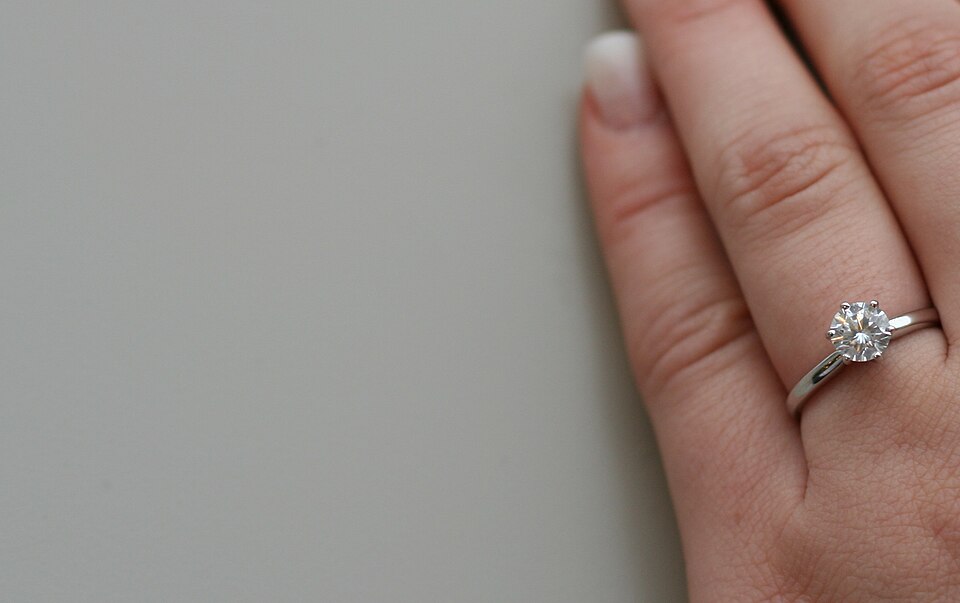
Image Credit: wikimedia.org
The conversation about lab-grown diamonds has shifted significantly in the past few years. What was once a niche alternative discussed mainly in price-sensitive buying guides has become a serious first consideration for buyers who are informed, intentional, and not particularly interested in paying a premium for something they cannot see or feel in the finished ring.
Yet despite growing mainstream awareness, the actual science and practical implications of choosing a lab-grown diamond are still poorly understood by most buyers. The misinformation runs in both directions. Detractors suggest lab-grown diamonds are somehow inferior or fake. Advocates sometimes overstate the environmental case without nuance. The buyer sitting in the middle trying to make a considered decision often ends up more confused after reading about it than before.
What follows is an attempt to give you the information that actually helps.
What a Lab-Grown Diamond Actually Is
A lab-grown diamond is not a simulant. It is not cubic zirconia, moissanite, or glass. It is a diamond. Chemically, physically, and optically identical to a diamond formed underground over billions of years under extreme pressure and heat.
The difference is origin and time. A natural diamond forms in the earth’s mantle and reaches the surface through volcanic activity over geological timescales. A lab-grown diamond forms in a controlled environment over a period of weeks to months, replicating the conditions that produce a natural diamond but doing so with precision and speed that geology cannot match.
Both are carbon atoms arranged in a cubic crystal structure. Both have the same hardness, the same refractive index, the same thermal conductivity, the same visual properties. A trained gemologist using specialist equipment can distinguish them. A person wearing one on their finger every day cannot.
The Two Methods of Production and Why They Matter
Lab-grown diamonds are produced through one of two processes. Understanding the difference helps explain why some lab-grown diamonds are priced differently from others and why quality varies across the category.
High Pressure High Temperature, known as HPHT, replicates the conditions of natural diamond formation by subjecting a carbon source to extreme pressure and temperature in a controlled environment. HPHT has been used in industrial diamond production for decades and produces gem-quality diamonds that are chemically indistinguishable from natural stones. Diamonds produced through HPHT sometimes retain a slight metallic flux residue that specialist equipment can detect, which is one of the identifiers gemologists use to distinguish them from natural stones.
Chemical Vapour Deposition, known as CVD, grows diamonds from a carbon-rich gas in a vacuum chamber. A seed diamond is placed in the chamber and carbon atoms gradually deposit onto it, building the crystal layer by layer. CVD technology has advanced rapidly and now produces some of the highest quality lab-grown diamonds available. CVD stones tend to have fewer inclusions and more consistent colour than some HPHT stones, though both methods produce gem-quality results across the grading range.
For the buyer, the practical implication is that the method of production matters less than the grading certificate attached to the finished stone. Both IGI and GIA grade lab-grown diamonds using the same four-characteristic system as natural diamonds. An IGI-certified lab-grown diamond with specified cut, colour, clarity, and carat grades has been independently verified against the same standards as any other diamond.
The Price Difference and What It Represents
Lab-grown diamonds typically cost 50 to 80 percent less than natural diamonds of equivalent certified grades. This price difference has widened significantly as production technology has scaled and become more efficient over the past five years.
The price of a lab-grown diamond reflects its production cost and the efficiency of the process rather than rarity. Natural diamonds command a premium partly because of genuine scarcity and partly because of decades of marketing that attached emotional significance to geological origin. Neither factor affects what the diamond looks like on a finger or how it performs in light.
For buyers, the practical implication of the price difference is meaningful. A budget that buys a one carat natural diamond of modest colour and clarity grades can typically secure a significantly larger, better-graded lab-grown diamond. The visual result is a more impressive stone for the same spend.
This is not a compromise. It is a different allocation of value. The buyer who chooses a lab-grown diamond is not accepting less. They are redirecting the premium they would have paid for geological origin toward cut quality, size, or setting craftsmanship.
The Environmental Question Handled Honestly
Lab-grown diamonds are often marketed as the ethical or sustainable alternative to mined diamonds. The reality is more nuanced than the marketing suggests and it is worth understanding before the environmental argument becomes a significant factor in your decision.
Diamond mining has genuine environmental impacts. Open-pit mining disturbs land, requires significant water use, and produces waste rock. The ethical sourcing of natural diamonds has improved significantly since the Kimberley Process was introduced in 2003 to restrict conflict diamonds, but concerns about labour conditions and environmental management persist in some producing regions.
Lab-grown diamond production is energy intensive. The HPHT and CVD processes require significant electricity. The environmental footprint of a lab-grown diamond depends heavily on the energy source used to power the production facility. A facility powered by renewable energy has a very different carbon footprint from one powered by coal. This information is not always transparently disclosed by producers.
The honest position is that lab-grown diamonds have a smaller land and water footprint than mined diamonds. Their carbon footprint depends on the energy mix of the production facility and is not uniformly lower across all producers. If environmental impact is a significant factor in your decision, asking the retailer about the specific producer and their energy sourcing is a more useful approach than assuming all lab-grown diamonds have a lower environmental impact than all natural diamonds.
Why Hatton Garden Matters for Lab-Grown Diamond Buyers
The quality of a lab diamond engagement ring is not determined solely by the stone. The setting, the craftsmanship, and the sourcing process all shape the finished piece.
Lab-grown diamonds are graded and certified in the same way as natural diamonds, but the sourcing landscape is different. The supply chain for lab-grown stones is newer and less established than the centuries-old natural diamond trade. Working with a jeweller who has genuine sourcing relationships and understands how to evaluate lab-grown stone quality across different producers and certification standards gives a buyer access to selection that online retail alone cannot replicate.
At Regal – Hatton Garden Jewellers, the approach to lab-grown diamond engagement rings starts from the same place as the approach to natural stones. The brief determines the stone rather than the available inventory determining the brief. With access to an extensive inventory of both natural and lab-grown diamonds sourced worldwide, the process of identifying the right stone for a specific buyer begins with understanding what they actually want rather than with presenting what is in stock.
The craftsmanship that holds the stone is made in Hatton Garden, London’s historic jewellery district, where the concentration of specialist setters, diamond merchants, and independent jewellers has built an ecosystem of expertise that cannot be replicated in a single workshop elsewhere.
The Resale Question Answered Honestly
Lab-grown diamonds do not retain value in the same way as natural diamonds. This is the most significant practical distinction between the two categories and it deserves to be stated clearly rather than buried in small print.
The resale market for lab-grown diamonds is less established and less liquid than for natural diamonds. As production costs continue to fall and supply increases, the resale value of lab-grown stones is likely to continue declining relative to natural diamonds. If you purchase a lab-grown diamond engagement ring with any expectation of significant resale value, that expectation is unlikely to be met.
For buyers who are purchasing an engagement ring as an object of permanent emotional significance with no expectation of resale, this distinction is irrelevant. The ring will be worn every day, passed down through a family, or simply treasured for what it represents rather than what it could be sold for. In that context the resale market is not part of the decision.
For buyers with any investment motivation or inheritance consideration, natural diamonds retain more predictable long-term value and the price premium they carry reflects that characteristic among others.
Understanding this distinction before the purchase means the decision is fully informed rather than partially so. A fully informed buyer who chooses lab-grown has made the right choice for their priorities. A buyer who discovers the resale reality after the purchase has been given incomplete information.
The Practical Starting Point
If you are considering a lab-grown diamond engagement ring, the most useful starting point is the same as for any engagement ring. Establish what matters most to you: the appearance of the stone at a given budget, the ethical sourcing considerations, the long-term value question, or some combination of all three.
Then work with a jeweller who will give you honest answers to the questions you bring rather than answers shaped by what they have in stock. The best engagement ring decision is an informed one, and the best jeweller is the one who helps you get there.